The food · Tsukiji Outer Market 築地場外市場 · verified 2 August 2026
Tsukiji is not one meal. It's a dozen ¥150–¥900 bites from named, addressable shops — plus one item that can quietly cost ¥24,500 — on a clock that starts at 03:00 and has lost its headline dishes by 13:30. Every price below carries a source and an as-of date, because the official site publishes almost none. The one skill that makes the crawl work: know which stall closes first, not which has the longest queue.
Everything below was verified as listed and trading on the market's official store list on 2 August 2026. Prices are third-party observations with dates — the official pages publish hours and products, almost never prices — so treat each figure as order-of-magnitude and read the board before ordering. Fresh-food inflation ran 3.3% year-on-year through 2025 (Reuters), and it shows.
~¥150–300 skewer · as of 2026
The emblematic bite, and the market's best value. Three makers within two minutes of each other: Yamacho (sweetest, sushi-rice-matched, the only one open 365 days, to 15:30), Marutake (the kids-and-picky-eaters pick — but its egg-on-a-stick sells only from 08:00), Shoro (dashi-forward, less sweet). Try two side by side — queue length between them measures Instagram, not quality. Sunday plan: Yamacho trades.
Sells out early · no published price
Shoro's cult item: thick omelette and Japanese mayonnaise in milk bread. The shop opens at 04:00 and the sando is a morning-only proposition in practice — a food blogger found no walk-around portion at all on one visit, so if you want the skewer format instead, Yamacho is the safer bet. Pairs with the sushi breakfast circuit rather than replacing it.
¥870 · as of 2026, was ¥850 — read the board
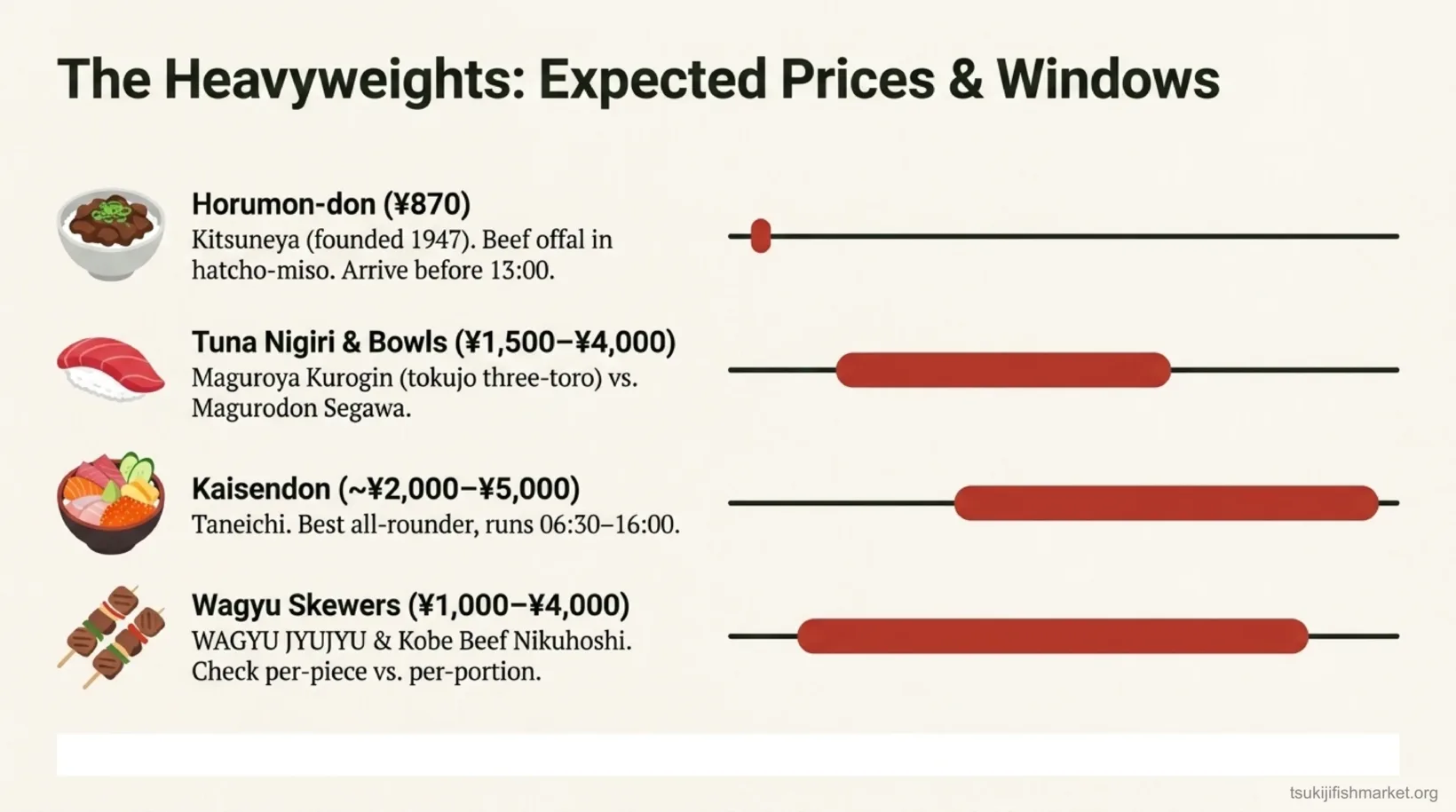
Kitsuneya, founded 1947: beef offal simmered in hatcho-miso, over rice — devised by the current owner's grandfather, a clog-maker who liked a drink. The market-worker dish and the signature queue, but it turns fast: twenty people is roughly fifteen minutes. Cash only, no reservations, and the stew cannot be ordered without the rice. Official close 13:30; Tabelog says 13:00 — arrive before 13:00. Skip the three cramped pot-side seats for the standing tables. More on the queue itself in chapter 03.
¥1,500–4,000 set · as of 2026
Maguroya Kurogin is the headline: tokujo three-toro nigiri (kamatoro, otoro, chutoro two pieces each) — and the shortest window in the market, 08:00 or 08:30 to 12:30 “while stocks last”. JAL's guide reports popular items gone before noon; treat 11:00 as the real deadline. Magurodon Segawa (also 12:30, next door to Kitsuneya) is the one-product tuna-bowl alternative. A five-piece plate can be ¥2,000 at one counter and double that next door — the spread is real. Missed both? Taneichi runs to 16:00.
~¥2,000–5,000 · as of 2026
Taneichi (4-9-5) is the best all-rounder and the longest-open bowl shop, 06:30–16:00: house kaisendon with uni, tuna, ikura, octopus and grilled egg, plus a full don menu from negitoro to uni-ikura. Sushizanmai Honten is not a connoisseur pick but trades 24 hours, 365 days, cards accepted — the only guaranteed meal at 03:00 or on a market closed day.
¥6,100–24,500 at Uni-Tora · shop menu dated 30 Jul 2026
The biggest budget risk in the market — research it before you point. Reuters reported (August 2025) that warming seas cut the northern catch and roughly doubled uni prices in a few years. Uni-Tora Honten publishes the market's most transparent menu: anago-and-uni ¥6,100, today's uni-don (70g) ¥8,300, five-origin tasting ¥14,500, top “Kotei” bowl ¥24,500, tax included. 34 seats, bookable, cards taken. The cheap route to the same ingredient: a small cup over rice from a grill stall, roughly ¥500–1,200 by grade, or Taneichi's uni-don. Budget maths in the FAQ.
~¥500 steamed or raw · as of 2026
Kouragumi Tsukiji 2 (4-9-4, 08:00–14:00) is the most complete grill counter: raw oysters and raw uni alongside grilled crab, shrimp and eel. Saito Suisan's two branches (06:00–17:00, open 365 days) are the late-afternoon and closed-day fallback. Japanese local guides also point to less-crowded Nakahara Suisan and Yorikisuisan for better-priced oysters one lane deeper — the standing rule that walking one lane in finds the same food without the wait.
¥500–800 jumbo scallop · as of 2026
A giant Hokkaido scallop caramelising in butter and soy is the single most photogenic thing on the crawl — and one of the few grills still trading after lunch: Tokyo Cheapo's June 2026 walk-through found shellfish and crab legs going as late as 15:30. Kouragumi and Saito Suisan again; gluten-free visitors can ask for plain grilled scallop with lemon instead of soy — more dietary workarounds on the practical page.
¥1,000–4,000 · highly variable — read the board
The item where visitors get surprised: one traveller reported ¥4,000 for a single premium skewer, while a plain salt-only beef cup can be ¥1,000. Per-piece and per-portion pricing get confused — check before ordering. WAGYU JYUJYU (06:30–14:00) does A5 fillet, sirloin and rump skewers plus uni-topped versions; Kobe Beef Nikuhoshi (07:00–15:00) is an authorised Kobe retailer with skewers, steak and curry. Both are post-2018 arrivals, not old guard — context on the history page.
¥280 · as of Feb 2024 — likely higher now
The best small find in the sweets category: Sanokiya casts its taiyaki in the shape of a tuna, not a sea bream — hon-maguro (crisp batter, Tokachi azuki), kihada (custard) and chu-toro (chewy batter, azuki plus apricot). Sells out and closes early, and its two official pages disagree on when it opens (7:00 in English, 8:00 in Japanese — see the note in chapter 06). The complete non-raw, kid-safe crawl in one stop.
Under ¥999 band · smoothie ¥650, as of 2026
Tsukiji Soratsuki (4-11-10, 08:00–15:00) is the market's most photographed sweet — and a double trap: takeout only with no seats, and cash only despite being one of the highest-traffic tourist stops. Allergen labelling available. Its sister shop Akamon runs side-by-side uni tastings — a cheaper way to compare origins than the big tasting bowls. Find sanctioned places to actually eat it in chapter 04.
No published menu · hours verified 2 Aug 2026
enikaitamochi Tsukiji (4-7-5, 10:00–19:00, no closed days) is the answer to “everything shut at 14:00” — the latest-opening and latest-closing sweet stop, with warabi lattes, dango and daifuku. Keeps an allergen-free menu with three gluten-free mochi including chocolate — rare at any stall. Takes cards and transport IC, unlike most of the sweets lane. More closed-day fallbacks on the calendar page.
~¥218–310 · as of 2026
Marutoyo (4-9-9) opens at 03:00 — the earliest shop you'd actually want to eat at, and the right first stop if you've come from the Toyosu auction dawn. Oversized hand-pressed onigiri with a daily queue for the tuna sushi rolls, plus curry-don and soups. Open to 15:00.
~$54 unlimited pours · captured 2 Aug 2026
The one crawl item that genuinely needs booking: a standing sake bar won't walk you through prefectures, but the unlimited sake tasting in Tsukiji (★ 4.9 · 71 reviews) does — and it sits inside the market, so it slots into the crawl as the seated break the lanes otherwise never give you. Best taken as the finisher, not the opener.
Nothing on the crawl can be booked, ticketed or queue-skipped — so the only lever you have is time. Toyosu's anxiety is queues; Tsukiji's is closings. Guides that import Toyosu's logic send people to stand at 05:00 outside stalls that open at 08:00, then wonder why everything worth eating is gone at 13:00.
The 14:00–15:30 footnote, honestly labelled. On a June 2026 walk-through, Tokyo Cheapo recorded fatty-tuna sushi selections at half price and shell grills still trading in this window — the cheapest hour of the day, barely covered in English. It is a single-sourced, dated observation: no shop advertises it and no second source confirms it, so treat it as a pleasant possibility, never a plan. Observation dated June 2026
Closed days are shop-specific, not market-wide: Yamacho, Saito Suisan, Uni-Tora, enikaitamochi, WAGYU JYUJYU and Sushizanmai all trade on Sundays, while the old guard follows the wholesale calendar's Sundays, holidays and selected Wednesdays. Marutake's oddity: closed Sundays only in January and August. The full grid lives on the hours & calendars page.
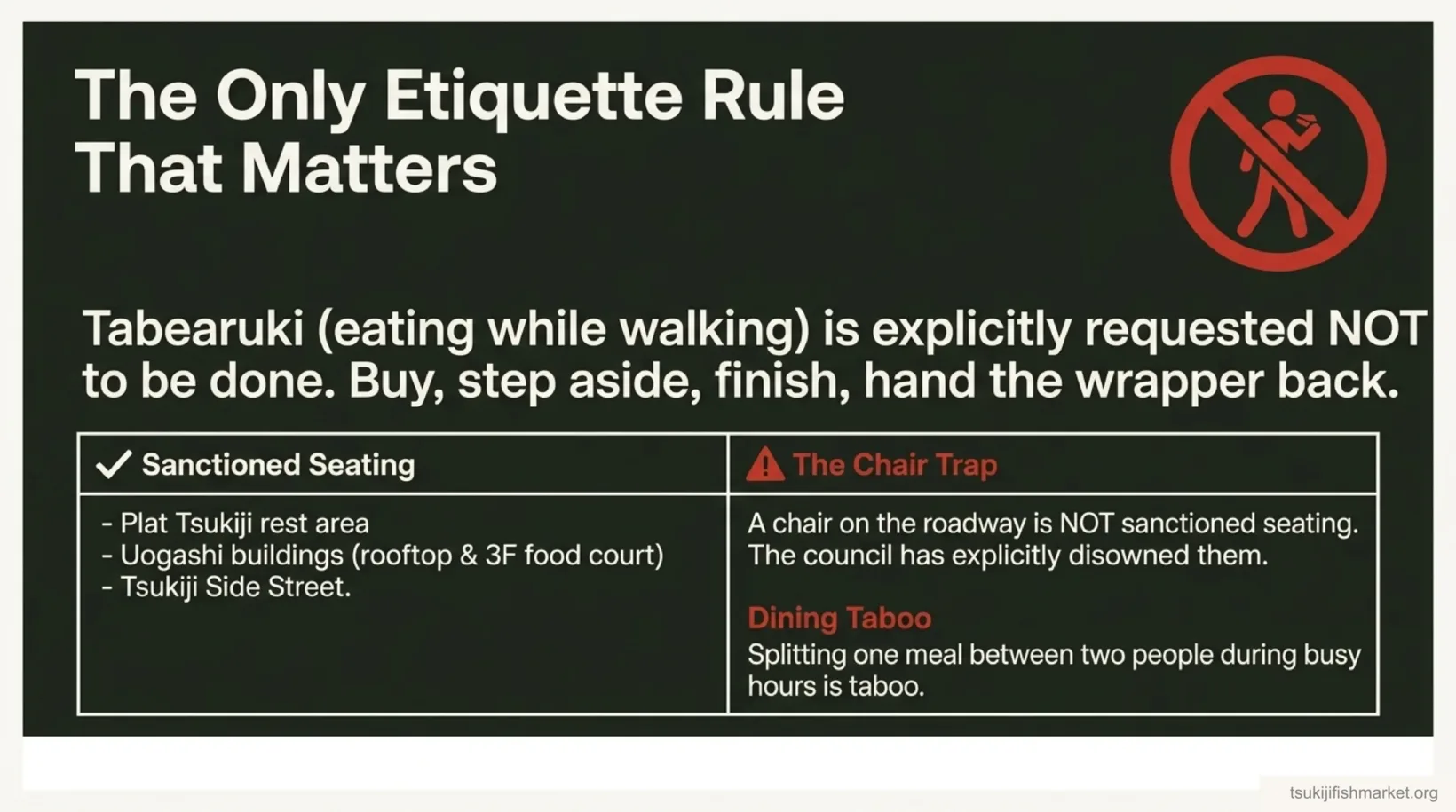
The Japanese name for a food crawl — tabearuki 食べ歩き — literally means “eating while walking”, which is precisely the thing the market's operators ask you not to do. Manner #2 of the official eight: “Stay inside the eatery or in front of the store when eating! Wandering around while eating can bother passerby.” The official guide map (edition 2026.2) is blunter still: “Do not eat while you are strolling. Please stay at the shop until you finish your food.” Buy, step aside, finish, hand the wrapper back to the vendor, move on.
A chair on the roadway is not sanctioned seating. Some shops set out chairs and tables on the carriageway itself. The council and the shopping-street association have publicly asked them to stop — in identical notices in November 2024 and November 2025 — and say the requests have regrettably gone unheeded; they strongly recommend customers use shops with properly sited seating on their own premises. So “sit where they put a chair” and “sit somewhere sanctioned” are not the same thing.
Two more that catch visitors out: splitting one meal between two people is generally taboo during busy hours — order one each, or buy from takeout stalls if you want to sample widely — and free samples are offered on the assumption you're considering a purchase, not as a tasting menu. The full eight manners, with consequences, are on the visiting responsibly page.
“Tsukiji is cash only” is the most repeated line about the market, and it's checkable rather than guessable: we crawled every shop page on the market's own directory — 333 shops — on 2 August 2026. Only 71 shops (21%) publish a payment policy at all. Of those 71: 58 take cards, 7 are cash-only, and 3 publish no cash option at all. The other 262 say nothing — and silence is absence of data, not evidence of cash-only.
| The traps worth naming | Detail |
|---|---|
| Cashless-ONLY | Kururi Zushi / GINie CAFE (4-7-5) is officially listed as “No cash” — it will not take your yen. The exact inverse of the market's reputation. |
| Card minimum | Tsukiji Miyukido's English page reads “CASH · CREDIT CARD” followed by an untranslated Japanese condition: cards only on purchases of ¥5,000 or more. |
| Cash-only headliners | Kitsuneya and Soratsuki publish no official payment row but are confirmed cash-only elsewhere — and they're two of the highest-traffic stops on this page. |
| English-page gap | WAGYU JYUJYU lists its payment methods (cards, IC, smartphone) only on its Japanese page. A blank English page is not a cash-only verdict — check the Japanese page at the same shop ID. |
The practical rule: carry ¥5,000–10,000 per person in ¥1,000 notes and coins so you can pay fast in a line, plus one card for the sit-down meal. There's a Seven Bank ATM that takes foreign cards inside Plat Tsukiji — details on the practical page.
A widely-read 2026 guide instructing you to break the market's central rule. The official manners and the official map both say: don't eat while strolling — eat at the shop or in a designated area. Chapter 04 lists where.
Measurably overstated. Of the 71 shops that publish a payment policy, 58 take cards — and one takes no cash at all. Cash-first, yes; cash-only, no. The numbers are in chapter 05.
Half-true and half-costly. The signature dishes are gone by 13:30, yes — but Yamacho runs to 15:30, Taneichi to 16:00, Saito Suisan to 17:00, enikaitamochi to 19:00, Uni-Tora's listing to 20:00, Sushizanmai around the clock. The ladder is chapter 03.
No such shop exists here. A full-text search of every food-category page on the official store list returns zero hits — Kimuraya is the historic anpan bakery in Ginza, ten minutes away. Tsukiji's daifuku shops are Soratsuki, enikaitamochi and Wako, all carded above.
Even the official site disagrees with itself. We fetched both language versions of 23 shop pages on 2 August 2026: Sanokiya's English page says it opens at 7:00, its Japanese page says 8:00 (and still carries a defunct COVID-era clause); Tamahaci's and Taneichi's English pages state Sunday closures their Japanese pages don't; WAGYU JYUJYU's payment row exists only in Japanese. When pages conflict, the Japanese version is likelier maintained — and when it matters, the shop's own board that morning is the only truth.
The crawl has no access barrier: no reservations, no lottery, no queue-skip to sell. Every shop above sits on a public official page with hours and an address, so a guided food tour is buying commentary, ordering vocabulary and routing — on top of food you could buy directly for ¥2,500–4,000. That's real value for some visitors and padding for others. One honesty note for 2026: in December 2025 the district council, citing overtourism, asked operators to refrain from guided food strolls during the year-end crush — a December-scoped request to operators, not a visitor ban, and not reissued as of early August 2026. Small self-guided groups are what the market itself asks for; if you book, book small.
No — the market's own rule, in its manners and on its map: eat at the shop or in a designated area, never while strolling. Sanctioned seating is listed in chapter 04; the roadway chairs some shops put out are explicitly not sanctioned.
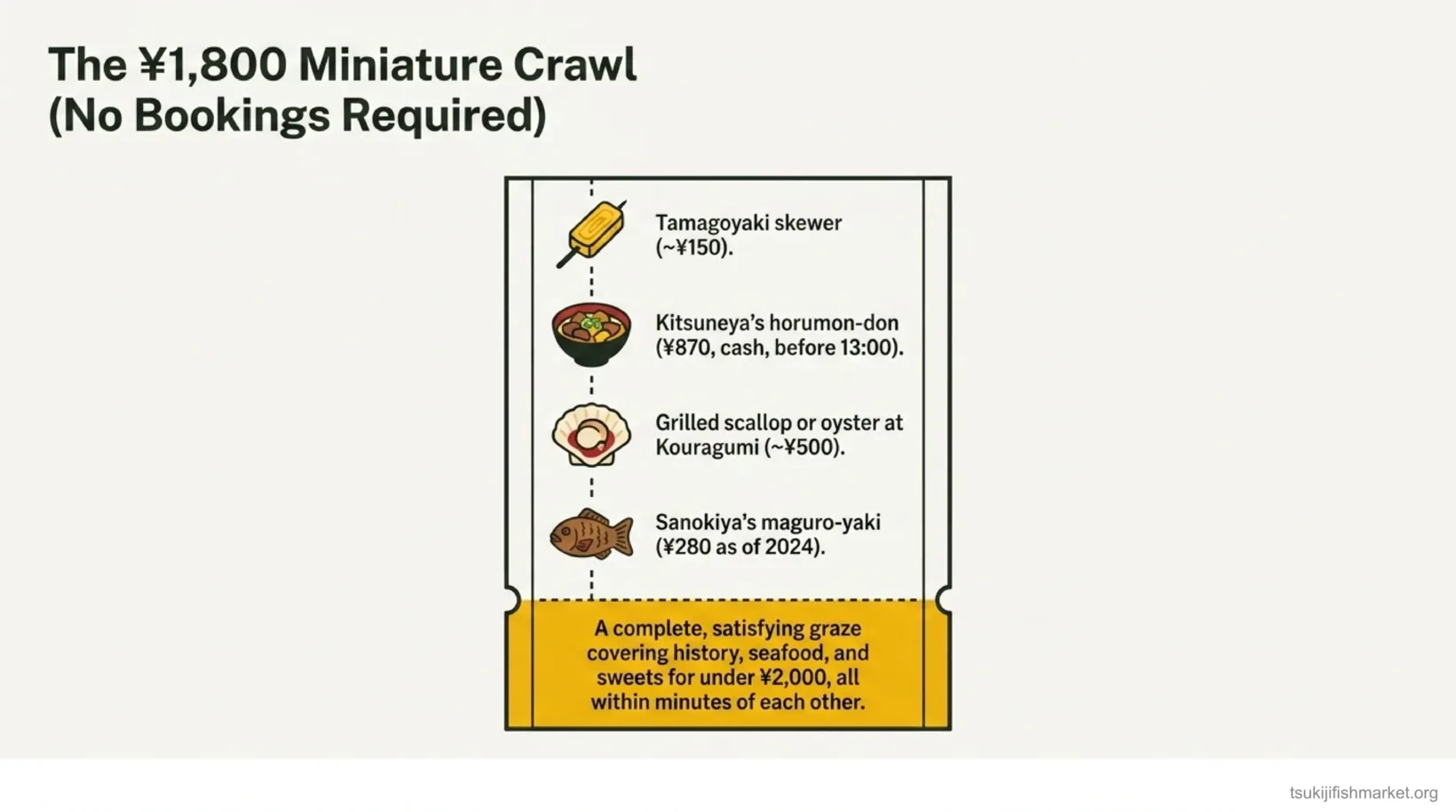
The ¥1,800 miniature crawl: a tamagoyaki skewer (~¥150), Kitsuneya's horumon-don (¥870, cash, before 13:00), a grilled scallop or oyster (~¥500) at Kouragumi, and Sanokiya's tuna-shaped maguro-yaki (¥280 as of 2024). All within a few minutes of each other, no bookings anywhere.
Earlier than guides admit. Kurogin officially trades to 12:30 but closes when stock runs out — JAL reports popular items gone before noon, so 11:00 is the working deadline for the market's most photographed tuna. Segawa also closes 12:30, Kitsuneya 13:30, the grills 14:00. Full ladder in chapter 03.
Bring both. Of 71 shops publishing a payment policy, 58 take cards, 7 are cash-only, and one takes no cash at all — but the headline stops Kitsuneya and Soratsuki are cash-only, so carry ¥5,000–10,000 in small notes. ATM at Plat Tsukiji. Details in chapter 05.
Different, not better: Yamacho sweetest (and open 365 days, to 15:30), Shoro dashi-forward with the cult sando, Marutake the kids' pick. They're two minutes apart — the correct answer is two of them, back to back.
Usually — the line moves faster than it looks. Twenty people is roughly fifteen minutes, because rice bowls are eaten fast. Cash, before 13:00, standing tables over the three pot-side seats, and know the offal stew only comes over rice.
Warming seas cut the northern catch and roughly doubled prices in a few years (Reuters, August 2025). Uni-Tora's tasting bowls run ¥6,100–24,500; the budget routes are a ¥500–1,200 cup from a grill stall or Taneichi's uni-don. Decide before you're standing at the counter.
Yes: the Plat Tsukiji rest area, the Uogashi rooftop and 3F food court (to 19:00), and the newer Side Street complex at 4-10-17 (no official hours published — a bonus, not a plan). Ground-floor eating in the wholesale buildings is prohibited, and roadway chairs are disowned by the council itself.
No — nothing on the crawl is reservable, and anyone selling queue-skip access to a Tsukiji stall is selling nothing. The exceptions are sit-down restaurants (Uni-Tora books its 34 seats online) and experiences like the sake tasting or a class. Plan around closings instead.