The verdict
Tsukiji stopped being Tokyo's wholesale fish market on 11 October 2018, when the auctions and the wholesalers moved to Toyosu. What stayed is the outer market: the streets of shops and small restaurants that grew up around the old wholesale site. Some of those shops turned their fronts towards visitors. Many did not, because their customers are still cooks.
- Touristy: the luxury bites sold for the camera, the longest queues, and the late-morning crush in lanes that were never built for crowds. Prices there are set for people who will not come back.
- Not touristy: the trade shops (knives, dried bonito, seaweed, tea, tableware, packaging) and the fish counters of the Tsukiji Uogashi building, which give professional buyers first call until 9:00 and sell at prices set for regulars.
- How to get the good half: a trading day, 9:00 to about noon, small bites from the shops that make them, eaten where you bought them. The details are in chapter 04 and chapter 05.
- Do you need a guide? No. Nothing here is ticketed or bookable. A guide sells a route and context; whether that is worth it is in chapter 06.
If you came for the tuna auction, you are in the wrong market: it is at Toyosu, and the free gallery opens at 5:00. The difference between the two places, and a plan for doing both in one morning, is on Tsukiji vs Toyosu.
What is genuinely touristy

The price of the photogenic items
A small number of items carry most of the bad reviews: premium beef skewers, giant crab legs, tasting flights of sea urchin. They are real food, often good food, but they are priced for one-off buyers, and the price on the board is not always the price per piece you assumed. Two examples from the dated checks on our food page: wagyu skewers ranged from about ¥1,000 to ¥4,000 depending on cut and stall (as reported in August 2026; read the board), and the menu at the sea-urchin specialist Uni-Tora ran from ¥6,100 to ¥24,500 a bowl, tax included, on the menu the shop dated 30 July 2026. Neither is a scam. Both are a lot to pay without checking first.
The crowds, and when they hurt
The market's own pages describe the outer market as narrow streets and small shops, and ask visitors not to move in large groups. When the lanes fill, eating at the counter, queuing and shopping all slow down together. The worst stretch of the year is the last week of December, when Tokyo households buy for New Year. In its November 2025 notice to shoppers, the market's management council called 25 to 30 December 2025 the peak, the days when every shop is open. For that December it also asked tour guides to refrain from guided walks, food-tasting tours and group leading. When we read the council's news page on 31 October 2026, nothing similar had been posted for December 2026; the 2025 notices went up in the last week of November, so look again from about 20 November. The whole story is on visiting responsibly.
The queues that measure fame
A long line at Tsukiji tells you a stall is famous. It does not tell you the food is better than at the counter next to it. Some queues are worth it because they move fast and the food is cheap: Kitsuneya's offal stew over rice was ¥870 at our August 2026 check, and it is eaten at the stall's standing tables. A line for a ¥4,000 skewer is a different decision.
What is not touristy
Look at the categories in the market's own shop directory and the trade is obvious: tuna, salted and dried fish, dried bonito flakes, seaweed and green tea, pickles, cooking utensils and kitchenware, knives, Japanese tableware, wrapping and packaging. Those shops exist because restaurants buy from them. The official calendar sets out the deal in its hours: 6:00 to 9:00 are professional buyers' hours, 9:00 to 14:00 are public buyers' hours, and after 14:00 each shop keeps its own time.

- The Tsukiji Uogashi building. Chuo City built it as a fresh-food market for about 60 shops, many of them retail counters run by intermediate wholesalers. From 5:00 to 9:00 they sell to professional buyers first, and the city asks general visitors to come after 9:00. All shops trade from 7:00 to 14:00 and the building closes at 15:00, on Sundays, national holidays and the designated Wednesdays. Eating on the ground floor is not allowed; eat on the rooftop plaza or in the third-floor rest space, or sit down at the Uogashi Shokudo food hall upstairs. The full guide is on the Uogashi building.
- The knife houses. Aritsugu, Masamoto, Sugimoto, Masahisa and Nenohi sell the same knives to chefs and to you, engrave them free at three of the houses, and do not haggle. The market's manners put it plainly: products are sold at wholesale prices and bargaining is not customary. Shop by shop on knives & shopping.
- The dried-goods trade. The bonito and kelp houses are professionals' shops: one states on its own site that it will not weigh out less than 500 g. That is not a trap; it is a supply shop that tolerates visitors. Smaller counters sell by weight from 50 g.
- The cheap things made in front of you. Tamagoyaki is the emblem. Yamacho's own price list sells its rolled omelette to take home at ¥350 for a third-size piece and ¥800 for the full one, tax included (read on the shop's site, 31 October 2026); at our 2026 checks the fresh skewer sold at the counters cost ¥150 to ¥300 across the makers, a rice ball ¥218 to ¥310, an oyster about ¥500 and a grilled scallop ¥500 to ¥800. Prices by stall, each with its date, are on the food page.
Two of the eight official manners do more than anything else to keep this half intact: professional buyers take priority in the morning, and food is eaten inside the eatery, in front of the shop that sold it, or in a space set aside for eating. Follow both and the trade shops treat you like any other customer.
When to go
- 06:00Professional buyers' hours on the official calendar. Shops are open, but this is their busiest work. Stay out of the way, or spend it at Toyosu.
- 09:00Public buyers' hours begin. The market's own sample day starts here: 9:00 at the Plat Tsukiji information centre, 9:15 Namiyoke Inari Shrine, 9:30 strolling and shopping.
- 11:00Lunch, in that same itinerary, and it recommends eating slightly early. The sought-after counters sell out; plan around closing times, not queue length.
- 12:00Where the official itinerary finishes. A sensible point to leave if the lanes are packed.
- 14:00Public hours end. After this each shop sets its own hours, and many close.
The day of the week matters as much as the hour. Saturday is the busiest ordinary day: the market trades fully, so everything is open and everyone comes; if Saturday is your only chance, be in the lanes by 9:00. Sunday runs a reduced, later lineup: it is a closing day on the market calendar, about a third of the shops (mainly eateries) open anyway, and many of them start later, so the usable window is roughly 9:00 to 14:00, and the Uogashi building stays shut. Tuesday, Thursday and Friday give the best mix of open shops and manageable crowds. The day-by-day detail is on hours & calendars.
The days matter as much as the hours. The official calendar follows the Tokyo wholesale market and adds that each shop keeps its own schedule, so a closing day is quieter rather than dark: some restaurants still open. For the next two months the calendar reads:
| Month | Closing days on the market calendar | Worth knowing |
|---|---|---|
| November 2026 | 1, 3, 8, 11, 15, 18, 22, 23, 29 | Wednesdays 4 and 25 November are trading days |
| December 2026 | 2, 6, 9, 13, 16, 20, 23, 31 | Sunday 27 December is a special trading day; Wednesday 30 December trades |
The Uogashi building keeps its own rule: closed on Sundays, national holidays and the designated Wednesdays. The five calendars that govern the two markets, with the day-by-day detail, are on hours & calendars. Calendar read 31 October 2026
How not to overpay
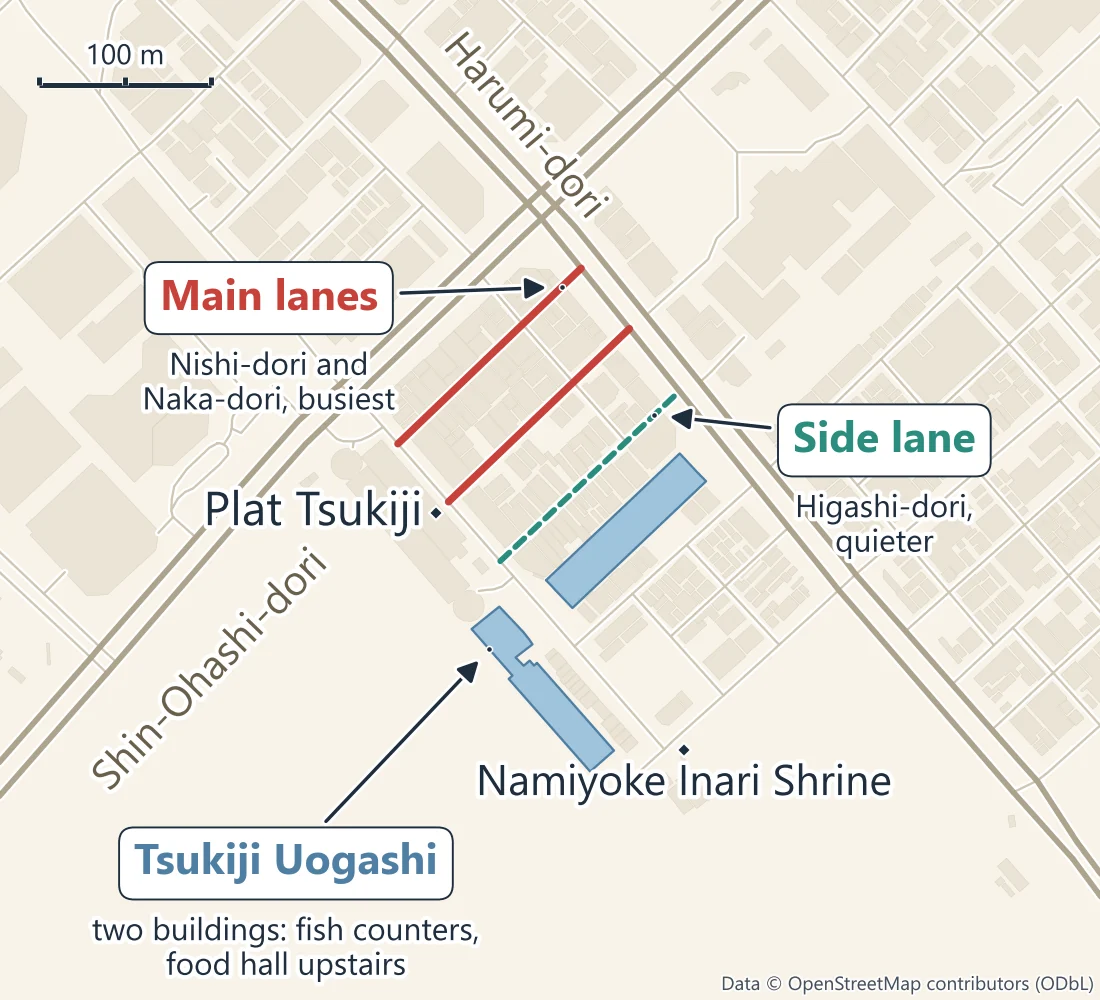
Most of the overpaying happens in a small area. On the market's own map the interior lanes run parallel to Shin-Ohashi-dori: Tsukiji Nishi-dori, Naka-dori and Higashi-dori. Nishi-dori and Naka-dori are the first two you meet from either station and by far the busiest, and the lanes get quieter the further you walk from Shin-Ohashi-dori. The lanes run from Harumi-dori at one end to Plat Tsukiji, the information centre with the ATM and the lockers, at the other; the two Tsukiji Uogashi buildings and Namiyoke Inari Shrine are a short walk south of Plat Tsukiji.
- Read the board before you queue. Know whether the price is per piece or per portion, and whether it includes tax. Shops do not all use the same basis: among the knife houses, some shelf prices include the 10% consumption tax and some do not.
- Buy the cheap classics, decide on the luxuries. Tamagoyaki, rice balls, a grilled scallop, a bowl from a market-worker counter: these are good value anywhere in the market. A premium skewer or a sea-urchin tasting flight is a deliberate splurge, not a snack.
- Know the total before you start. On the dated price checks on our food page (gathered in August 2026), a snack crawl of five or six bites ran about ¥1,200 to ¥2,500 a head, and one seafood bowl on top took it to ¥4,000 to ¥7,000. The cheapest four-bite route came to about ¥1,800: a tamagoyaki skewer (about ¥150), Kitsuneya's offal stew over rice (¥870), a grilled scallop or oyster (about ¥500) and a fish-shaped maguro-yaki (¥280, last confirmed in February 2024).
- Walk one lane in. Stalls on Tsukiji Higashi-dori and the back alleys sell many of the same foods as the main lanes, often with shorter waits.
- Go upstairs at Uogashi. The Uogashi Shokudo food hall on the third floor serves sit-down set meals, and a seat is the one thing the lanes cannot offer.
- Carry small notes and a card. When we read all 333 shop pages in the official directory on 2 August 2026, 71 shops stated a payment policy: 58 took cards, 7 were cash-only, and 3 took no cash at all. Some of the busiest food stalls are cash-only, so cash speeds up the queue; a card covers the sit-down meal. The full count is on the food page.
- Do not haggle. It is not the custom here, and it will not get you a better price.
- Leave the suitcase. The manners ask you to put large bags in a coin locker. Plat Tsukiji has lockers and will mind a stroller for ¥500.
Knives and other big purchases: from 1 November 2026, tax-free shopping in Japan is a refund. You pay the tax-inclusive price in the shop and get the tax back after customs confirms at your departure airport that you are taking the goods out. The sequence, and why customs comes before check-in, is on knives & shopping.
Is a guided food tour worth it?
Be clear about what you are buying. Every shop at Tsukiji is open to anyone, nothing needs a ticket, and no tour can get you into anything you could not walk into yourself. A guide sells a route, the ordering, and the stories behind the food. For a first morning in Japan, or with allergies that make reading labels a safety issue, that can be worth paying for. If you are happy to point, pay and eat at the counter, the self-guided morning above works well and costs only the food.
If you do want company, the format matters more than the brand. A guide-fee-only walk costs little and you pay the shops directly, at the prices regulars pay. A tastings-included walk bundles the food into a much higher price. A class trades the lanes for a kitchen. Pick by the morning you want:
Tokyo: Tsukiji Fish Market Guided Walking Tour
The honest answer to the trap question: a guide who points you to the shops, and you pay the counter price for what you eat.
Check the walk →Tsukiji Fish Market Food Walking Tour with 5 Tastings
Five stops chosen and paid for. You pay well over the counter price of the food for having it handled.
Check the tastings →Tsukiji Fish Market Sushi Making Class with Pro Chef
Skip the crowds entirely: a kitchen near the market, a chef, and the sushi you make yourself.
Check the class →Prices, ratings and review counts read on GetYourGuide on 31 October 2026 unless marked; operators change prices by season, so the booking page is the final word.
Every format, including private guides and the Toyosu auction walks, is in the tours & classes catalogue, where we explain how we choose them.
Quick answers
Yes, if you come for what is still real: knives, dried bonito, seaweed, tableware and fish sold to cooks, and cheap bites made in front of you. Go on a trading day from 9:00, eat at the stall that sold you the food, and treat the luxury items as a splurge you choose, not a snack.
No, but it is cash-first. Of the 71 shops that stated a payment policy in the official directory on 2 August 2026, 58 took cards, 7 were cash-only and 3 took no cash at all. Several busy food stalls are cash-only, so carry small notes as well as a card.
About 9:00 on a weekday the calendar marks as a trading day. Before 9:00 is for professional buyers; 9:00 to 14:00 are the public hours. The market's own sample itinerary runs from 9:00 to noon with lunch at 11:00. Saturday is the busiest ordinary day, and Sunday runs a reduced, later lineup.
In November 2026: 1, 3, 8, 11, 15, 18, 22, 23 and 29 November. In December 2026: 2, 6, 9, 13, 16, 20, 23 and 31 December, with Sunday 27 December a special trading day. Each shop keeps its own hours, so some restaurants open on closing days. Detail on hours & calendars.
For some people. Nothing at Tsukiji needs a ticket, so a tour buys a route and context, not access. A guide-fee-only walk is the cheapest way to get that; a tastings-included walk costs several times more. If you are happy to point and pay, go on your own. The options are in chapter 06.
No. Eat inside the eatery, in front of the shop that sold the food, or in a space set aside for eating. In the Uogashi building the ground floor is off limits for eating; use the rooftop plaza or the third-floor rest space. More on visiting responsibly.